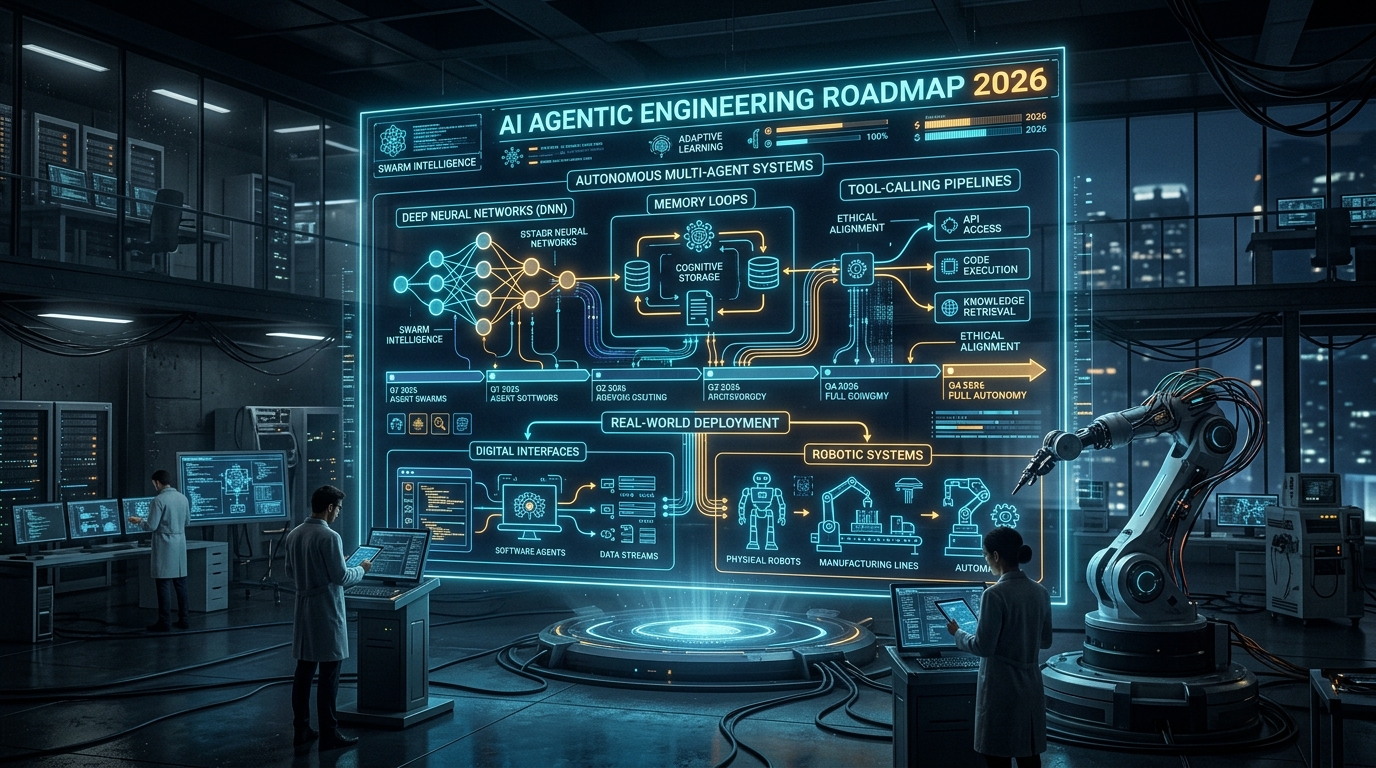
No pierdas 2 años: La Guía y Hoja de Ruta Definitiva para convertirte en Ingeniero de Agentes IA en 2026

El panorama de la Inteligencia Artificial ha experimentado un cambio de paradigma monumental. En 2024 y 2025, la industria estaba fascinada con el prompting básico y los chatbots aislados. En 2026, la era de los chatbots simples ha terminado. Toda la industria tecnológica está migrando hacia la Ingeniería de Agentes de IA (AI Agentic Engineering): la disciplina formal de construir sistemas deterministas, autónomos y multi-agente capaces de razonar en múltiples fases, ejecutar herramientas, autocorregirse y operar en flujos de producción de software de misión crítica.
Esta clase magistral deconstruye la hoja de ruta técnica exacta, paso a paso, necesaria para convertirte en un Ingeniero de Agentes de élite sin perder años en tutoriales obsoletos o humo comercial.
1. Qué significa realmente "IA Agéntica" (Superando el marketing)
Cuando Andrew Ng acuñó el término "agéntico" para describir cómo los desarrolladores estaban estructurando flujos de trabajo alrededor de los LLMs, representó un avance técnico fundamental. Sin embargo, el marketing rápidamente le pegó la etiqueta a cualquier chatbot básico.
Un verdadero Sistema Agéntico no es un prompt ejecutado en un bucle ciego. Es una arquitectura de ingeniería determinista caracterizada por cuatro capacidades no negociables:
1. Reflexión y Autocorrección (Reflection): El agente inspecciona su propio resultado intermedio, ejecuta pruebas unitarias o linters, detecta fallas y refina su respuesta de manera autónoma antes de entregarla.
2. Uso de Herramientas y Llamadas a Funciones (Tool Calling): El agente interactúa con el entorno exterior: bases de datos, APIs REST, motores de búsqueda, terminales aisladas y compiladores.
3. Planificación y Descomposición (Planning): El agente divide objetivos complejos y ambiguos en subtareas ordenadas y las ejecuta de forma secuencial o paralela.
4. Colaboración Multi-Agente (Multi-Agent Orchestration): Múltiples agentes especializados (ej. Investigador, Programador, Revisor de Código, QA) colaboran y se evalúan mutuamente mediante protocolos de comunicación estructurados.
2. Pilares Arquitectónicos de un Sistema Agéntico
flowchart TD
    UserQuery["🎯 Objetivo del Usuario / Regla de Negocio"] --> Planner["🧠 Motor de Planificación & Descomposición"]
    Planner --> Orchestrator["⚙️ Orquestador Multi-Agente"]

    subgraph Agent_Core ["🤖 Entorno de Ejecución del Agente"]
        Orchestrator --> Agent1["Agente Alfa (Análisis y Código)"]
        Agent1 --> Tools["🛠️ Ejecución de Herramientas & Sandbox"]
        Tools --> Evaluator["🧪 Filtro de Evaluación & Linters"]
        Evaluator -- "Aprobado" --> Memory["💾 Memoria Semántica & Episódica"]
        Evaluator -- "Error en Pruebas (Traceback)" --> Agent1
    end

    Memory --> Synthesizer["📊 Sintetizador & Verificador"]
    Synthesizer --> FinalResult["✅ Entregable Productivo Determinista"]
3. Hoja de Ruta Curricular de Ingeniería de Agentes 2026
Fase 1: Dominio Profundo de Python y Arquitectura Asíncrona
Para construir bucles de agentes rápidos y escalables, el Python síncrono tradicional no es suficiente. Debes dominar:
* asyncio, concurrencia y gestión de pools de tareas.
* Validación estricta de datos con Pydantic v2.
* Flujos de entrada/salida en streaming y arquitecturas orientadas a eventos.
Fase 2: Ingeniería de Contexto y Protocolos de Herramientas
- Dominio del estándar Model Context Protocol (MCP) para descubrimiento y ejecución universal de herramientas.
- Diseño de esquemas JSON robustos para llamadas deterministas a funciones.
- Poda dinámica de contexto para evitar la degradación de la atención del modelo.
Fase 3: Sistemas de Memoria y Recuperación de Conocimiento
- RAG Híbrido (Búsqueda vectorial densa + Búsqueda dispersa BM25 + Reciprocal Rank Fusion).
- Grafos de Conocimiento (Graph RAG) para razonamiento relacional de múltiples saltos.
- Arquitecturas de memoria persistente a corto y largo plazo.
Fase 4: Orquestación Multi-Agente y Evaluaciones en Producción
- Frameworks avanzados de grafos de estado (LangGraph, CrewAI, AutoGen, Custom StateGraphs).
- Bancos de pruebas deterministas (Eval harnesses): evaluación continua de agentes contra benchmarks de verdad fundamental.
- Ejecución de código en sandboxes aislados con Docker / microVMs Firecracker.
4. Transcripción Íntegra & Deconstrucción Paso a Paso
A continuación se presenta el desarrollo continuo y las lecciones desglosadas de la clase magistral para su lectura y escucha sincronizada:
Don't Waste 2 Years: The Complete Roadmap to Becoming an AI Agentic Engineer in 2026
The artificial intelligence landscape has undergone a monumental paradigm shift. In 2024 and 2025, the industry was captivated by basic prompting and naive chatbots. In 2026, the era of standalone chatbots is dead. The entire industry is transitioning toward AI Agentic Engineering—the disciplined practice of building deterministic, autonomous, multi-agent systems capable of multi-step reasoning, tool execution, self-correction, and production-grade software workflows.
This masterclass deconstructs the exact, step-by-step roadmap required to become an elite AI Agentic Engineer without wasting years on outdated tutorials or hype.
1. What "Agentic AI" Really Means (Moving Past the Marketing Hype)
When Andrew Ng coined the term "agentic" to describe how developers were building workflows around LLMs, it represented an important engineering breakthrough. However, marketing hype quickly slapped the label onto everything.
A true Agentic System is not a single prompt in a loop. It is a deterministic architecture characterized by four fundamental capabilities:
1. Reflection & Self-Correction: The agent inspects its intermediate output, runs unit tests or linters, identifies flaws, and refines its response autonomously.
2. Tool Use & Function Calling: The agent interacts with external environments—databases, APIs, web search, sandboxed terminals, and compilers.
3. Planning & Task Decomposition: The agent breaks complex, ambiguous goals into ordered sub-tasks and executes them sequentially or in parallel.
4. Multi-Agent Collaboration: Specialized agents (e.g. Researcher, Coder, Reviewer, QA) collaborate and challenge each other via structured message protocols.
2. Core Architectural Pillars of an Agentic System
flowchart TD
    UserQuery["🎯 User Objective / Business Goal"] --> Planner["🧠 Planning & Decomposition Engine"]
    Planner --> Orchestrator["⚙️ Multi-Agent Orchestrator"]

    subgraph Agent_Core ["🤖 Autonomous Agent Runtime"]
        Orchestrator --> Agent1["Agent Alpha (Analysis & Code Gen)"]
        Agent1 --> Tools["🛠️ Tool Execution & Sandbox API"]
        Tools --> Evaluator["🧪 Evaluation & Linting Gate"]
        Evaluator -- "Pass" --> Memory["💾 Epistemic & Semantic Memory"]
        Evaluator -- "Fail (Error Trace)" --> Agent1
    end

    Memory --> Synthesizer["📊 Output Synthesizer & Verifier"]
    Synthesizer --> FinalResult["✅ Deterministic Production Deliverable"]
3. The 2026 Agentic Engineering Curriculum
Phase 1: Python Mastery & Async Architecture
To build fast agentic loops, synchronous Python is insufficient. You must master:
* asyncio, concurrency, and task pooling.
* Structured data validation with Pydantic v2.
* Streaming I/O and event-driven architectures.
Phase 2: Context Engineering & Tool Calling Protocols
- Mastery of Model Context Protocol (MCP) for standardized tool discovery and execution.
- Schema design for deterministic JSON function calling.
- Dynamic context pruning to avoid transformer attention degradation.
Phase 3: Memory Systems & Knowledge Retrieval
- Hybrid RAG (Dense Vector Search + BM25 Sparse Search + Reciprocal Rank Fusion).
- Knowledge Graphs (Graph RAG) for relational multi-hop reasoning.
- Persistent short-term and long-term memory architectures.
Phase 4: Multi-Agent Orchestration & Evals
- Multi-agent frameworks (LangGraph, CrewAI, AutoGen, Custom StateGraph).
- Deterministic eval harnesses: unit testing agents against ground-truth benchmarks.
- Sandboxed code execution with Docker / Firecracker microVMs.
4. Full Lecture Transcript & Verbatim Insights
When I coined the term agentic to describe what I saw as a important and rapidly growing trend in how people were building on-base applications what I did not realize was that a bunch of marketers would get hold of this term and use it as a sticker and put this on almost everything in sight and that has caused hype on agentic AI to skyrocket The good news, though, is that ignoring the hype
the number of truly valuable and useful applications built using agentic AI has also grown very rapidly Even if not quite as rapidly as the hype And in this course what I'd like to do is show you best practices for building agentic AI applications and just open up a lot of new opportunities to you in terms of what you can now build Today agentic workflows are being used to build applications like customer
support agents or to do deep research to help write deeply insightful research reports or to process tricky legal documents or to locate patient input and render To suggest possible medical diagnoses On many of my teams a lot of the projects we built just would be impossible without agentic workflows And so knowing how to build applications with them is one of the most important and valuable skills in AI today. It turns out
that one of the biggest differences I've seen between people that really know how to build agentic workflows compared to people that are less effective at it is the ability to drive a disciplined development process specifically one focused on evals and Error analysis And in this course I'll tell you what that means and show you what allows you to be really good at building these agentic workflows Being able to do this is
one of the most important skills in AI today and will open up a lot more opportunities be it job opportunities or opportunities to just build amazing software yourself With that let's go on to the next video to dive more into what are agentic workflows So what is agentic AI and why are agentic AI workflows so powerful? Let's take a look The way that many of us use large language models or LLMs
today is by prompting it to say write an essay for us on a certain topic X And I think of that as akin to going to a human or in this case going to an AI and asking it to please type out an essay for me by writing from the first word to the last word all in one go and without ever using backspace It turns out that we as people we
don't Do our best writing like that by being forced to write in this completely linear order and nor do AI models But despite the difficulty of being constrained to writing this way our LMs do surprisingly well In contrast, with an agentic work though this is what the process might look like You may ask it to first write an essay outline and then set the topic Then ask if it needs to do
any web research And after doing some web research and maybe downloading some web pages then to write the first draft and then to read the first draft and see what parts need revision or Research and then revise the draft and so on And this type of workflow is more akin to doing some thinking and some research and then doing some revision and then doing some more thinking and so on. And with
this iterative process it turns out that an agentic workflow can take longer but it delivers a much better work product So an agentic AI workflow is a process where an LLM-based app executes multiple steps to complete a task In this example you might use an LLM to Write the first essay outline and then you may use an LLM to decide what search terms to type into a web search engine or really
what search terms to call a web search API with in order to get back relevant web pages. Based on that you can feed the downloaded web pages into an LLM to have it write the first draft and then maybe use another LLM to reflect and decide what needs more revision And then depending on how you design this workflow Perhaps you may even add a human in the loop step where the LLM
has the option to request human review maybe of some key facts and based on that it may then revise the draft and this process results in a much better work output One of the key skills you learn in this course is how to take a complex task like writing an essay and breaking it down into smaller steps for agentic workflow to execute one step at a time To then get the work
output that you want And knowing how to decompose the task into steps and how to build the components to execute the individual steps well turns out to be a tricky but important skill that will determine your ability to build agentic workflows for a huge range of exciting applications. In this course a running example that we'll use and something that you build alongside me is a research agent So here's an example of
what it will look like You can enter a research topic like How do I build a new rocket company to compete with SpaceX? I don't personally want to compete with SpaceX but if you want to you can try asking a research agent to help you background research So this agent starts with planning out what research to use including calling a web search engine to download some web pages and then to synthesize
and rank findings draw up a outline have an exit agent review for coherence and then finally Read a comprehensive markdown report which it has done here building on the rocket company with SpaceX with the intro, background, findings, and so on And I think the points are appropriately that this is going to be a tough startup to build so I'm not personally planning to do this but if you want to tackle something
like this maybe a research agent like this could help you with some initial research And by finding and downloading multiple sources and deeply Thinking about it this actually ends up with a much more thoughtful report than just prompting an LLM to write an essay for you would One of the reasons I'm excited about this is because in my work I've ended up building quite a few specialized research agents be it in
legal documents for conflict legal compliance or for some healthcare sectors or some business product research areas And so I hope that working through this example you not only learn how to build agentic workflows for Other applications but that some of the ideas in building research agents will be directly useful to you if you ever need to build a custom research agent yourself Now one of the Often discuss areas of AI agents
is how autonomous are they? What you just saw here was a relatively complex highly autonomous agentic AI workflow but there are also other simpler workflows that are incredibly valuable Let's go into the next video to talk about the degree to which agentic workflows can be autonomous and does it give you a framework to think about how you might go about building different applications and how easy or difficult they might be? See
you in the next video Agents can be autonomous to different degrees A few years ago I noticed within the AI community that there was a growing controversial debate about what is an agent and some people are writing a paper saying a built-in agent and others say no that's not really a true agent and I felt this debate was unnecessary which is why I started using the term agentic because I thought if
we use it as an adjective rather than a binary it's either an agent or not then Can have physical knowledge that systems can be agentic to different degrees and let's just call out agentic and move on with the real work of building these systems rather than debating you know is this sufficiently autonomous to be an agent or not? I remember when I prepared a talk on agentic reasoning one of my team
members actually came to me and said "Hey, Andrew, we don't need yet another word You know, we have agent Why you make up another word agentic?" But I decided to use it anyway And then later on wrote an article in Give them the newsletter the batch and then also post on social media saying that instead of arguing over which words include exclude as being a true agent let's acknowledge the different degrees
to which systems can be agentic And I think this helped move past the debate on what is a true agent and let us just focus on actually building them Some agents can be less autonomous So take the example of writing an essay about black holes You can have a relatively simple Agents to come up with a few web search terms or web search queries then you can hard code in that you
call a web search engine fetch some web pages and then use that to write an essay And this would be an example of a less autonomous agent with a fully deterministic sequence of steps and this will work okay In terms of notational convention throughout this course, I'll use the red color as you see here on the left to denote the user input such as a user query in this case or in
later example Maybe the input document into an agentic workflow The gray boxes denote calls to an LM and the green boxes like the web search and the web fetch boxes that you see here indicate steps where other software is being used to carry out an action such as a web search API call or excluding code to fetch the contents of a website. Then an agent can be more autonomous where, given a
request to write an essay about black holes perhaps you let the LM decide does it want to do a Search or does it want to search recent news sources or does it want to search for recent research papers on the website archive? Based on that, maybe in this example the LLM, not the human engineer but the LLM chooses in this case to call web search engine And then after that you may
let the LLM decide how many web pages does it want to fetch or if it fetch the PDF does it need to call a function or also call the tool to convert the PDF to text? And in this case maybe it fetches its top few web Pages then it can write an essay decide whether to reflect and improve and maybe even go back to fetch more web pages and then finally produce
an output And so even for this example of a research agent we can see that some agents can be less autonomous with a linear sequence of steps to be executed determined by a programmer and some can be more autonomous where you trust the OM to make more decisions and the exact sequence of steps that happens may be even determined by the OM rather than in a By the programmer So for less
autonomous systems you will usually have all the steps predetermined in advance and any functions it calls like web search, and we'll call that tool use as you learn in the third module in this course might be hard-coded by the human engineer by you or me and most of the autonomy is in what text the LLM generates At the end of the spectrum would be highly autonomous agents where the agent makes many
decisions autonomously including, for example deciding what is the sequence of steps it will carry out In order to write the essay and there's some highly autonomous agents that can even write new functions or we sometimes say create new tools that it can then execute And somewhere in between are semi-autonomous agents where can make some decisions choose tools but the tools are usually more predefined As you look at different examples in this
course you learn how to build applications anywhere on this spectrum of less to more highly autonomous And you find that there are tons of applications in the less autonomous end of the spectrum They're very valuable Built for tons of businesses today And at the same time there are also applications being worked on at the more highly autonomous end of the spectrum but those are usually less easily controllable a little bit more
unpredictable and also a lot of active research as well to figure out how to build these more highly autonomous agents And with that let's go on to the next video to dive deeper into this and to hear about some of the benefits of using agents and why they allow us to do things that just were not possible with earlier generations of LLM-based applications I think the one biggest benefit of agentic workflows